The ʿitrah did not appoint the jurists as deputies over the Ummah during the time of occultation
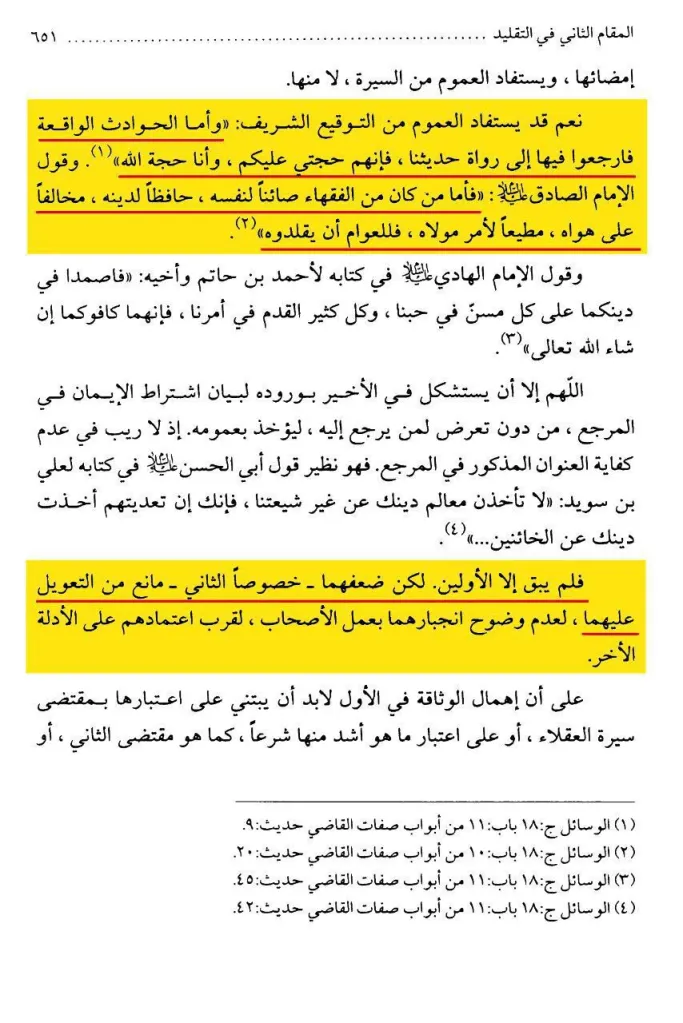
The ʿitrah (the Prophet’s household) did not appoint the jurists as deputies over the Ummah during the time of occultation; rather, this was a voluntary assumption they took upon themselves. Thus, there is no legitimate authority for the jurists, nor has the ʿitrah been present for twelve centuries! How could it be otherwise, when the matter at hand requires decisiveness and certainty, not mere conjecture? It is therefore correct to say that this is a collapsed structure with a ruined foundation; and that there is no excuse for distorting the statement of the Wise Lawgiver from “the Book of God and my ʿitrah” into “the Book of God and the Shiʿa of my ʿitrah” as the basis for adherence!
Sayyid Muḥammad Saʿīd al-Ḥakīm [al-Kāfī fī Uṣūl al-Fiqh, 2/651]: the most famous texts relied upon regarding the will of the Awaited Mahdī to return to jurists and transmitters of hadith during the occultation—namely, “As for newly occurring events, refer to the transmitters of our hadith,” and the narration “Whoever among the jurists is … then the common people may emulate him”—both reports are weak. Consequently, deputation, the collection of dues, the Imam’s share, and the representation of the ʿitrah by jurists after the occultation became matters that Imami jurists volunteered on behalf of God and the ʿitrah, without any definitive bequest to them—except for analogies drawn with the companions of the Imams before the occultation. Yet analogy is invalid and misguidance according to the Imamis. Moreover, the Imams’ instructions before the occultation to their companions were to return to them in matters they did not know, without exercising independent reasoning; those companions were merely transmitters of knowledge in a time when Imams were present. They cannot be analogized to scholars in the time of the Occulted Imam, for whom there is no known approval or disapproval of opinions. Thus, nothing remains to be relied upon except recourse to rational practice (al-sīrah al-ʿuqalāʾiyyah), as the Imamis themselves state—namely, people’s need to refer to scholars just as patients refer to doctors. But this may be acceptable from others and not from them, given their doctrines of infallibility, the negation of ijtihād and personal opinion, and the requirement of an Imam in every age for a rational cause: to prevent conflict among people, to draw them nearer to obedience and farther from disobedience—making this an obligation upon God, for without it commissioning would not be good, as an act of divine grace (luṭf). Hence, there is no basis except voluntary assumption and baseless assertion, and no sound effect! So who appointed you as deputies on behalf of God, His Messenger, and his Household?
There is no present ʿitrah, and no definitive deputation. After all the patchwork, it suffices to note that whatever the Imami issues will be nothing but conjectural, whereas the station of following here is one of decisiveness and certainty—so that it could be said that rejecting the jurist after the occultation is rejecting God, and that he should be empowered within the Ummah with the authorities of the walī al-faqīh which they today issue as a state. Even if the Imami sought a ladder to the heavens, he would not find the decisive proof. How so, when his most famous reports are weak, as his own scholars admit? How so, when his greatest supports are the reprehensible analogy—by their own standards—to the jurists of the present Imams before the occultation? How so, when rational practice is not complete unless the very principle of infallibility, its necessity, and its condition for attaining guidance are abandoned—leading to a breach of divine wisdom? By adopting this rational practice, they would thereby validate the Zaydi position, or else the Imamis’ own principles would be overturned.
May God grant you success.
O God, send prayers and peace upon Muhammad and upon the family of Muhammad
Translation of Ustadh Kadhim Al Zaydi (May Allah reward him)