The Abbasid Manufacturing of Imami Thought Against the Alid Revolts
Examining the Imamiyyah’s own sources
The Abbasid Manufacturing of Imami Thought Against the Alid Revolts
Imami scholars, transmitters, and trusted figures who served as close associates of Abbasid power — and how their proximity to the throne shaped a doctrine built to discourage revolt against tyrants.
An extremely important piece on the Abbasid manufacturing of Imami thought against the Alid — Hasanid and Husaynid — revolts. Imami scholars, men, and trusted figures who were close associates of Abbasid power. This piece is intellectual in nature and is aimed at researchers of Shi’ism.
The sultans of oppression and tyranny are the people most capable of manufacturing rigid sectarian doctrines that discourage revolt against tyrants. Whoever fails to grasp the substance of this picture will miss a great deal in understanding the history of how Imami Shi’ism was fashioned to reject and discourage the sayyids of the line of al-Hasan and al-Husayn, peace be upon them. Today people are more aware of the role tyrants play in manufacturing opinions and doctrines that serve their own agendas.
These observations lead the researcher to reconsider the history of Shi’ism and the construction of Imami thought as opposed to the Shi’ism held by the sayyids of the line of al-Hasan and al-Husayn, who advocated rising up against the Abbasids and revolting against them. The Abbasids therefore contrived to adopt that pacifist Imami line which rejected revolution and was built on the doctrine of “awaiting” the Mahdi, and which worked to discourage people from Zaydism and to belittle the standing of the sayyids of the line of al-Hasan and al-Husayn, peace be upon them. They fabricated numerous reports claiming that merit, knowledge, and textual designation (nass) belonged exclusively to a limited number of the good among the sons of al-Husayn, peace be upon them, and they invented the doctrine of taqiyya — religious dissimulation — in that fearsome form which misled the common Shi’a, so that they stopped paying attention to the rejection shown to them by the sons of al-Husayn, excusing it by saying their rejection was merely taqiyya. Likewise their doctrine of bada’ (divine change of decision), by which they made excuses through endless hopes for the appearance of the hidden one and the impermissibility of revolt before his appearance.
Among the notable men, figures, and transmitters of the Imamiyya were those who had close or strong ties to the Abbasids — this is drawn from the Imamiyya’s own sources — and the observer will find that the agenda behind all of this was to grant legitimacy in the eyes of the common Shi’a by fabricating reports praising these figures and confirming them in their Abbasid posts.
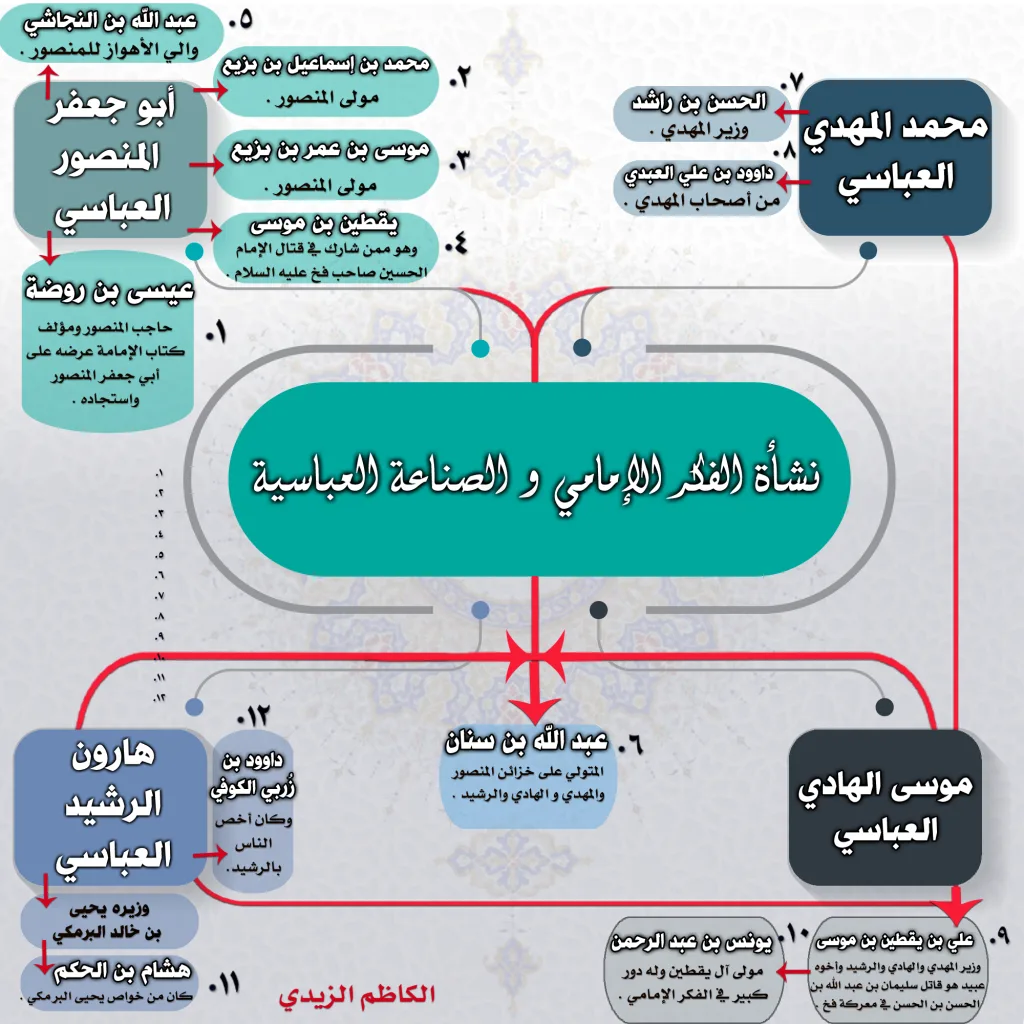
Thirteen figures with Abbasid ties
Figure 1 of 13
Isa ibn Rawda
Al-Najashi said he was the chamberlain of al-Mansur, a skilled theologian who wrote a book on the Imamate, which Ahmad ibn Abi Tahir described in his book on Baghdad, having seen it himself; some of our companions reported having seen this book too. It is also recorded that when al-Mansur was at al-Hira, he listened in on Isa ibn Rawda, his client (mawla), discussing the Imamate, and was impressed by him and admired his eloquence. Abd al-Husayn al-Shabistari described him as a knowledgeable, articulate theologian with works on the Imamate and theology, who grew close to the Abbasid court and became one of al-Mansur al-Dawaniqi’s chamberlains. Sayyid Hasan al-Sadr, after quoting al-Najashi, said he belonged to the early generation of Followers (tabi’in), preceding everyone who wrote or spoke on theology and the foundations of the sect, and is mentioned among the first authors in Ta’sis al-Shi’a, where al-Sadr called him “al-Mansur’s ally.” Al-Sadr further said he had a book on the Imamate and was unrivaled in his era in theology, being the one who opened its door and unveiled it. Abbas Iqbal Ashtiyani noted that he appears to have been the first Imami theologian to write a book on the Imamate and the first to debate opponents in this field — one of the Abbasid clients closely attached to al-Mansur.
Figure 2 of 13
Muhammad ibn Isma’il ibn Bazi’
A transmitter of Imami books and foundational texts, as mentioned by al-Tusi in al-Fihrist and by al-Najashi, who called him a client of al-Mansur Abu Ja’far, among the righteous and trustworthy members of this group, prolific in his work, with several books to his name. Sayyid al-Burujirdi remarked, commenting on someone who attributed him to the Adawi tribe, that describing him this way was unusual given that he was known for his loyalty to the Abbasids.
Figure 3 of 13
Musa ibn Umar ibn Bazi’
Al-Najashi described him as a client of al-Mansur, trustworthy, from Kufa, with a book to his name.
Figure 4 of 13
Yaqtin ibn Musa
He took part alongside the Abbasids in fighting against Imam al-Husayn ibn Ali, known as al-Fakhkhi, peace be upon him — see the accounts of the Battle of Fakhkh. Al-Tusi, in the biography of his son Ali ibn Yaqtin, said that Yaqtin remained in the service of al-Saffah and al-Mansur while still professing Shi’ism and belief in the Imamate, as did his son. His son Ali would later become one of the Abbasid viziers, as will be mentioned. It appears this man himself was an unfinished project for them — but he succeeded in shaping his sons.
Figure 5 of 13
Abdullah ibn al-Najashi al-Asadi
Al-Najashi mentions that he transmitted a letter from Abu Abdullah, the Imam, to him, and that he governed Ahwaz on behalf of al-Mansur. It appears from his case that he was originally Zaydi before becoming Imami, after which he became governor of Ahwaz.
Figure 6 of 13
Abdullah ibn Sinan ibn Tarif
Al-Najashi described him as treasurer for al-Mansur, al-Mahdi, al-Hadi, and al-Rashid — a Kufan, trustworthy, one of “our companions,” eminent, free of any criticism, with several books including one on prayer known as “The Work of a Day and a Night,” a larger book on prayer, and a book covering various chapters on the lawful and unlawful; many of our companions transmitted these books from him due to his stature, trustworthiness, and eminence within the sect. Al-Khu’i added that al-Shaykh al-Mufid counted him among the great jurists and leading authorities relied upon for matters of the lawful and unlawful, rulings and verdicts, who are free from any criticism or blame.
Figure 7 of 13
Al-Hasan ibn Rashid
Al-Barqi said he was a client of the Abbasids and served as vizier to al-Mahdi, then to Musa al-Hadi, then to Harun — and he has a book to his name.
Figure 8 of 13
Dawud ibn Ali al-Abdi
Al-Tusi said he was among the companions of al-Mahdi.
Figure 9 of 13
Ali ibn Yaqtin ibn Musa
His father, as mentioned, was among the companions of al-Saffah and Abu Ja’far and took part in the Battle of Fakhkh alongside the Abbasids. Ibn al-Najjar relates that al-Mahdi and Ali ibn Yaqtin grew up together like brothers; when al-Mahdi became caliph he appointed Ali ibn Yaqtin as vizier, placing him in charge of key administrative bureaus, a position he held until al-Mahdi’s death. Al-Hadi then confirmed him in the vizierate without sharing authority with anyone else until al-Hadi’s own death, after which al-Rashid kept him in post for a month before replacing him with Yahya ibn Khalid al-Barmaki. The crown prince Muhammad ibn al-Rashid led his funeral prayer. Al-Tusi described him as trustworthy, of great standing, and of immense stature within the sect, noting too that the crown prince led his funeral prayer, and that he left behind books. His brother, Ubayd ibn Yaqtin ibn Musa, was the one who killed Sulayman ibn Abdullah ibn al-Hasan ibn al-Hasan ibn Ali ibn Abi Talib, peace be upon them, an ancestor of the Prophetic family — see the accounts of the Battle of Fakhkh. The author notes that the Yaqtin family as a whole is highly suspect and warrants further investigation as an instance of constructed hostility and rejection of the Hasanid-Husaynid line.
Figure 10 of 13
Yunus ibn Abd al-Rahman
A client specifically of Ali ibn Yaqtin — worth the researcher’s reflection given his major role in shaping Imami thought. Al-Najashi described him as a client of Ali ibn Yaqtin ibn Musa, himself a client of the Banu Asad, an eminent and prominent figure among “our companions,” with many books to his name.
Figure 11 of 13
Hisham ibn al-Hakam
Closely associated with Harun’s vizier Yahya ibn Khalid al-Barmaki. Al-Khu’i records that he was among those who opened up theological discourse on the Imamate, refined the doctrine through rational argument, was skilled in dialectical theology, and quick with answers — and that he was devoted to Yahya ibn Khalid al-Barmaki, presiding over his theological sessions and discussions.
Figure 12 of 13
Dawud ibn Zirbi
Ibn Dawud al-Hilli said he was among the people closest to al-Rashid, and that he held the Imam Abu Abdullah in high regard — al-Najashi also vouched for his trustworthiness.
Figure 13 of 13
The period after the death of Imam al-Hasan al-Askari, and the agents (safirs)
Muhammad Wa’izzadeh al-Khurasani, tracing the history of Imami companions through the period of the hidden Imam, the confusion that arose, and the claims of representation (safara) for the hidden one — worth reflecting on the relationship between the Abbasids and Imami thought and its scholars at that time — notes that historical records and the hadiths transmitted from the Imams of the Household show that Shi’i figures held important posts in the capital and other lands. This becomes clearer still when we see that the caliphs deferred to the opinion of Shi’i leaders in declaring people like Ibn Abi al-Azaqir and al-Husayn ibn Mansur al-Hallaj to be unbelievers and having them expelled, even carrying out death sentences against them in line with their rulings — evidence that the Imami sect in the fourth Islamic century enjoyed official recognition at the Abbasid court, with its scholars’ opinions carrying great weight there.
The Zaydi reading of this history
It is also worth noting here that Zaydi thought holds that the Imamiyya were a creation of the Abbasid state, which exerted great influence over their doctrines and implanted them as opposition to the revolutionary sayyids of the line of al-Hasan and al-Husayn, the Imams of Zaydism, peace be upon them. They were given the doctrine of awaiting the Mahdi, of abstaining from jihad, and of restricting the textual designation (nass) to the descendants of al-Husayn alone — building on an earlier seed of rejectionism dating to the time of Imam Zayd ibn Ali, peace be upon him, which was then nurtured and expanded by Abu Ja’far al-Mansur al-Abbasi. Al-Mansur was renowned for his cunning, his command of ideas, and his skillful use of literary intrigue — as anyone familiar with his methods would know — and al-Ma’mun later did the same. Hence we find in Zaydi accounts a saying attributed to Harun al-Abbasi: he swore he had no real quarrel with the Imamiyya, and that if their Imam were to rise as they described, he would be the first to follow him — his true enemies, and those of his forefathers, were the Zaydis, who unsheathed their swords the moment any of their own rose up, having already washed and shrouded themselves in anticipation of paradise. As then, so now — political powers manufacture ideas and beliefs to use against the revolutionaries of justice.
The observer should further reflect on the claimed practice of taqiyya, and on the secrecy surrounding the Imams’ identification and the succession from one Imam to the next — all of which served to keep a portion of the Shi’a uninformed and discouraged from questioning, so that whenever they encountered a position contradicting their belief from the good among the sons of al-Husayn, they would dismiss it as taqiyya. Abu Ja’far’s policy, for anyone who studies it, was indeed successful.
Examples of this Abbasid construction, briefly
Report 1 of 10
A report in Wasa’il al-Shi’a relates that al-Husayn ibn Khalid asked Imam Abu al-Hasan al-Rida about a hadith transmitted by Abdullah ibn Bukayr, who reported from Ubayd ibn Zurara that he had been with Imam Abu Abdullah, al-Sadiq, during the uprising of Muhammad “Ibrahim” ibn Abdullah ibn al-Hasan, when a companion asked the Imam what he thought of joining the revolt. The Imam reportedly answered: remain still, as long as the heaven and earth remain still. Ibn Bukayr then concluded that, on this reasoning, there would never be any rising or any Riser (Qa’im), since heaven and earth never cease to be still. Al-Rida responded that Abu Abdullah had spoken truly, but Ibn Bukayr had misunderstood — what was meant by the heaven remaining still was the absence of a heavenly call announcing the Mahdi, and the earth remaining still meant the absence of an army being swallowed into the ground.
Comment — here both Abbasid objectives converge: first, discouraging support for the callers from the line of al-Hasan and al-Husayn, including sowing division within the Prophetic family; second, instilling in part of the Shi’a a doctrine of submission and non-revolt, so that they would not support any uprising before the Mahdi’s appearance.
Report 2 of 10
Another report in Wasa’il al-Shi’a, via al-Sayyari, has Imam Abu Abdullah being told of someone from the family of Muhammad who had risen up, and responding that he and his followers would always be well off as long as someone from the family of Muhammad kept rising, adding that he wished such a riser would emerge even if it cost him his household’s entire livelihood.
Comment — here too both objectives converge.
Report 3 of 10
A report in Wasa’il al-Shi’a, in the Prophet’s testament to Ali, states that moving the towering mountains would be easier than removing a kingship whose days have not yet run out.
Comment — reflect on how this serves to make people submit to Abbasid rule, similar to Mu’awiya’s claim that God had made him king over the people, meaning, in effect, do not oppose me. Yet by this logic al-Husayn ibn Ali’s revolt against the Umayyads would make no sense either, if Umayyad rule, in God’s knowledge, had not yet run its course. Imam al-Sadiq is far above being party to this kind of Abbasid fabrication found among reports attributed to his noble forefathers and descendants.
Report 4 of 10
Another report in Wasa’il al-Shi’a has al-Fadl the scribe relating that he was with Imam Abu Abdullah when a letter arrived from Abu Muslim; the Imam said the letter required no answer and told the messenger to leave, adding that God does not hasten for the haste of His servants, and that moving a mountain from its place would be easier than removing a kingship whose term has not ended — followed by a sign given for the appearance of al-Sufyani as the necessary precursor.
Comment — note here, as with the previous report, that this is not about whether Imam al-Sadiq doubted Abu Muslim’s sincerity — a Hasanid-Husaynid observer might indeed question that — but rather, his refusal to pledge allegiance to Abu Muslim or anyone else does not mean he rejected revolt against the Abbasids altogether, since on another front he supported his cousins, the Hasanid-Husaynid line, and held their position, having pledged allegiance to and supported his uncle Imam Zayd ibn Ali. The issue is rather this particular formulation that obligates believers to remain passive until the end of time in the face of tyranny, to the delight of tyrants, including the Abbasids of that era, revealing the true purpose behind the fabrication.
Report 5 of 10
Another report in Wasa’il al-Shi’a, via Yunus ibn Abd al-Rahman from al-‘Ays ibn al-Qasim, has Imam Abu Abdullah urging people to fear God and look after their own souls, since they have only one soul and cannot repeat life to correct past mistakes through trial — warning that if anyone of “us” comes calling them to our approval, “we” bear witness that we do not approve of anyone obeying us today while standing alone, asking how they could obey “us” once the banners and standards are raised.
Comment — again both prior objectives are present, and note that among the transmitters of this report is Muhammad ibn Isma’il ibn Bazi’, vizier to Abu Ja’far al-Mansur, and Yunus ibn Abd al-Rahman, client of the Abbasid vizier Ali ibn Yaqtin. Many such reports were fabricated and attached to noble figures within chains transmitted widely among the Shi’a, with constructed chains of transmission; God alone knows best.
Report 6 of 10
Another report in Wasa’il al-Shi’a has Imam Abu Abdullah listing five signs before the Riser’s appearance — the Cry, al-Sufyani, the Sinking, the killing of the Pure Soul, and al-Yamani — and when asked whether one should join an uprising by a member of his household before these signs appear, he answered no.
Comment — this again pleases the Abbasids and rejects the cause of the sayyids of al-Hasan and al-Husayn — indeed, by extension, even rejects more recent resistance movements — and one should consider who stands to benefit most from the death of revolution against oppressors, to understand the true origin of such reports; Imam al-Sadiq is innocent of them.
Report 7 of 10
Another report in Wasa’il al-Shi’a, via Abu Basir from Imam Abu Abdullah, states that any banner raised before the Riser’s appearance belongs to a tyrant worshipped instead of God.
Report 8 of 10
Another report has Imam Abu Ja’far speaking of dust raised by those who stir up haste, calling the impatient ones doomed, and saying that God will surely bring relief to those who restrain themselves and wait upon Him.
Report 9 of 10
Another report has Imam Abu Abdullah telling Sadir to stay confined to his house like a saddle-blanket left aside, remaining still through night and day, and only to set out toward them on foot once news arrived that al-Sufyani had risen.
Report 10 of 10
Al-Kulayni relates, through his chain reaching Ali ibn Yaqtin, that Imam Abu al-Hasan told him: “The Shi’a have been raised on false hopes for two hundred years.”
Comment — note here that this is reported through Ali ibn Yaqtin, vizier to the Abbasids al-Mahdi, al-Hadi, and Harun — reflecting that very same conditioning of the Shi’a on hopes of the Mahdi’s appearance and “awaiting,” together with the restriction of merit and the Imamate to the line of al-Husayn alone, follows directly from this.
Indeed, these reports are transmitted by al-Hurr al-‘Amili in Wasa’il al-Shi’a from various authoritative Imami sources, including al-Kafi and the works of al-Shaykh al-Saduq, among others — for the observer to reflect upon.
“As then, so now — political powers manufacture ideas and beliefs to use against the revolutionaries of justice.” — from the author’s reflection
May God grant you happiness.
O God, bless and grant peace upon Muhammad and the family of Muhammad.