Mujaddid al-Din al-Mu’ayyidi
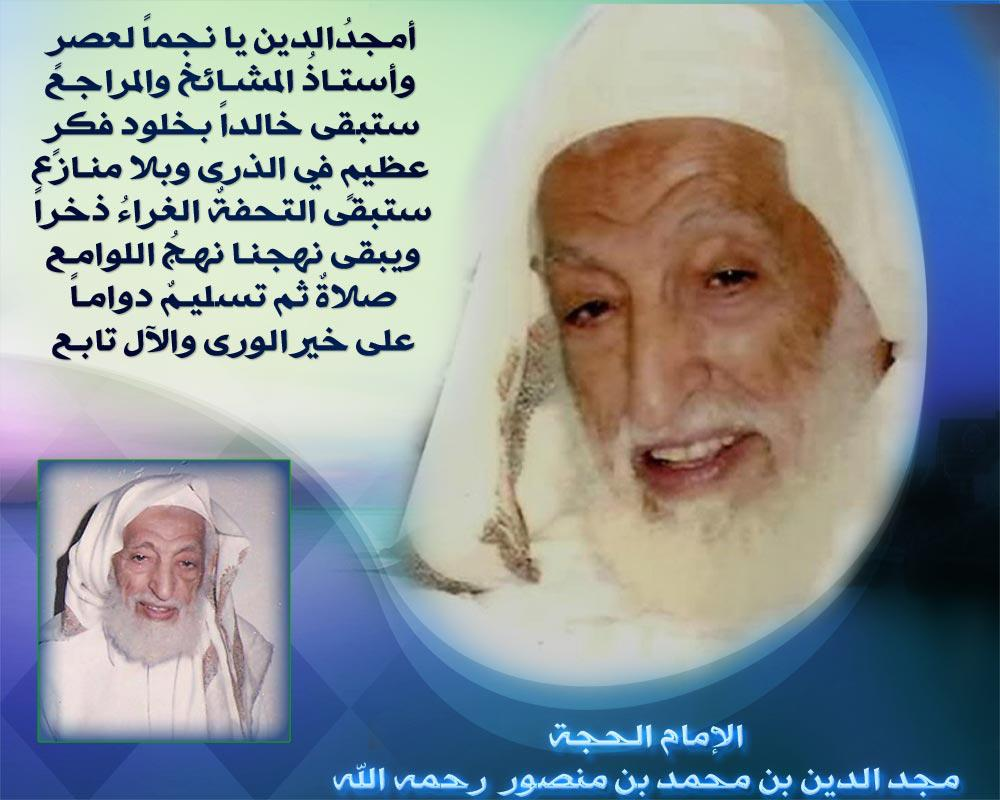
A devout, God-fearing scholar, jurist, mufti, teacher, guide, and author.
He was born in the village of al-Ridmah, in the district of Bart al-‘Anan, Jawf Governorate, on Sunday, Sha‘ban 26, 1332 AH (July 19, 1914 CE), and passed away in the city of Sa‘dah at sunset on Tuesday, Ramadan 6, 1428 AH (September 18, 2007 CE).
Al-Ridmah was the first hijrah of Zayn al-‘Abidin in his father’s era, where he moved from Dihyan, Sa‘dah, to stay close to Imam al-Mahdi li-Din Allah Muhammad ibn al-Qasim al-Husayni al-Houthi.
He lived 96 years, of which he spent 70 in teaching Islamic sciences and authoring encyclopedic jurisprudential and religious works, and 50 years in preserving Zaydi heritage and thought. He played a vital role in shaping the identity of the Zaydi school and reviving it after the leaders of the September 26, 1962 Revolution tried to extinguish its enlightening flame. Thanks to his efforts and those of his students, this Muhammadan ‘Alawi school became a destination for seekers of truth, moderation, and authentic Islam free from distortion and domestication.
He was among the eminent renewers of God’s religion, reviver of obligations and Prophetic traditions in Yemen, akin to the two great Imams al-Hadi Yahya ibn al-Husayn and al-Qasim ibn Muhammad. He became one of the great pillars of Zaydism, a pious ‘Alawi Hasani scholar whose reputation spread throughout Yemen and the Arabian Peninsula, earning respect and esteem from scholars and society alike.
Scholars of his time agreed that he was the mujaddid (renewer) foretold in Prophetic traditions to appear at the head of every century to revive the faith.
He was described by Shaykh Ali ibn Muhammad al-‘Ajri as “the magnet of those devoted to the Prophetic Shari‘a,” by Amir al-Din ibn al-Husayn al-Houthi as “the compass point of the Hasanis,” and by Muhammad ibn al-Hasan al-‘Ajri as “the Ka‘ba of those seeking guidance.”
He was tall, of moderate build, with an aquiline nose, radiant face, arched eyebrows, and a full beard, though lighter at the sides. His forehead was luminous, his face bright, with a Prophetic smile.
Born into a pious, learned family: his father was a religious authority of his time, described as unmatched in virtue and nobility. His mother, a chaste and devout noblewoman, was the daughter of Imam al-Mahdi Muhammad ibn al-Qasim al-Houthi. Remarkably, he combined descent from Imam al-Hasan ibn Ali (through his father) and Imam al-Husayn ibn Ali (through his mother), thus uniting the two noble lineages of the Prophet’s grandsons.
Education
From an early age he was passionate about knowledge, memorizing at age seven the text Mirqāt al-Usūl by Imam al-Qasim ibn Muhammad. Before reaching adulthood, he had attained high levels of scholarship and ijtihād. His contemporaries titled him “the Renewer,” and he became a widely respected reference in Yemen and the Arabian Peninsula.
He studied under many eminent scholars, including:
- His father
- Hasan ibn al-Husayn al-Houthi
- ‘Abdullah ibn al-Hasan al-Qasimi
- Muhammad ibn Ibrahim al-Mu’ayyidi (Ibn Hurriyah)
- Yahya ibn Salah al-Mu’ayyidi
- Hasan ibn Muhammad Suhayl
He received broad authorizations (ijazāt) in the Islamic sciences and their texts.
He devoted his life to teaching, writing, preaching, and guiding, leaving his mark in many parts of Yemen and beyond. Numerous generations of influential scholars graduated under his care, among them:
- Badr al-Din al-Houthi and his martyred brothers ‘Abd al-Karim and Hamid al-Din
- Muhammad ibn ‘Abd al-‘Azim al-Houthi
- Husayn ibn Hasan al-Houthi
- Ali ibn ‘Abdullah Sari al-Houthi
- Ibrahim ibn Ali al-Shahari
- Husayn ibn ‘Ali Habis
- Hasan ibn Muhammad al-Fayshi, his closest companion
- Salah ibn Ahmad Falitah
- And many others from Sa‘dah, Sana‘a, Hajja, Dhamar, and Najran
He also granted ijazāt to prominent figures such as Amir al-Din al-Houthi, Muhammad ibn Muhammad al-Mansur, Hamud ibn ‘Abbas al-Mu’ayyid, and scholars from Yemen and Iraq.
Struggle and Enlightenment
During the Monarchy:
He opposed the broadcasting of national songs with music on Radio Sana‘a, writing a treatise entitled “The Prohibition of Song and Instruments of Entertainment.” He never took political office, reportedly not recognizing Imam Ahmad’s legitimacy.
During the Republic:
After the 1962 Revolution, he and his family moved to Najran due to persecution of Zaydi scholars. Many were executed or imprisoned. He fought to preserve Zaydism, engaging in a preventive intellectual struggle that resulted in a renewed, enduring Zaydi identity. Politically, he withdrew from direct involvement but maintained principled opposition to illegitimate authority.
After Yemeni unification in 1990, he co-founded Hizb al-Haqq (The Party of Truth) with fellow scholars, combining Zaydi educational revival with political engagement.
Character and Traits
- Profound knowledge and tireless dedication: He spent his life in books, even on his wedding night he was found engrossed in study.
- Dignity and awe: His presence commanded respect. Even bandits once repented after his admonition.
- Detachment from ego: He welcomed truth from any source, swearing that he would follow it regardless of who presented it.
- Piety and asceticism: He renounced worldly wealth and positions, living simply and devoted to teaching and reconciliation.
- Moderation: He exemplified the Qur’anic middle path, avoiding extremes, encouraging dialogue, and offering accessible fatwas.
Writings
He authored about 50 works, including:
- Al-Jāmi‘ah al-Muhimmah fī Asānīd al-A’immah
- Lawāmi‘ al-Anwār fī Jawāmi‘ al-‘Ulūm wa al-Āthār (3 volumes, a major encyclopedic work)
- Iydāh al-Dalālah
- Al-Hujaj al-Munīrah
- Al-Jawāb al-Tām
- Majma‘ al-Fawā’id
- Al-Tuhaf al-Fātimiyyah
- Al-Balāgh al-Nāhī ‘an al-Ghinā’ wa Ālāt al-Malāhī
- Diwān al-Hikmah (poetry and aphorisms)
- And numerous treatises responding to theological, jurisprudential, and modern issues.
Praise from Scholars
- Hasan ibn Muhammad al-Fayshi: “The renewing Imam of the Prophet’s legacy, a vast ocean of transmitted and rational sciences.”
- ‘Abd al-Majid al-Houthi: “He embodied lofty virtues, loved by all, a unifier of Muslims and defender of Islam.”
- Ali ibn Yahya Qamis: “A sea of knowledge, eloquence, wisdom, and decisive reasoning.”
- Muhammad ibn al-Hasan al-‘Ajri: “The collector of the scattered sciences of Ahl al-Bayt, declaring truth morning and evening.”
Family
His sons: al-Husayn, al-Hasan, Ali, Ibrahim, and Isma‘il – all respected scholars.
Sources
This biography draws from writings of Hasan al-Fayshi, ‘Abd al-Majid al-Houthi, Ali ibn Yahya Qamis, Muhammad Ayash, the Zaydi Council, and various Yemeni and Islamic scholarly institutions.
✍️ By researcher Zayd Yahya al-Muhibshi